The Caucasus—a lesser-known region spanning Eastern Europe and Western Asia—was the focus of an international conference titled Caucasus: A Mosaic of Histories and Cultures, hosted by Irina Kostina, associate professor of instruction and coordinator of the Russian program at the University of Iowa (UI) on April 19-20, 2025.
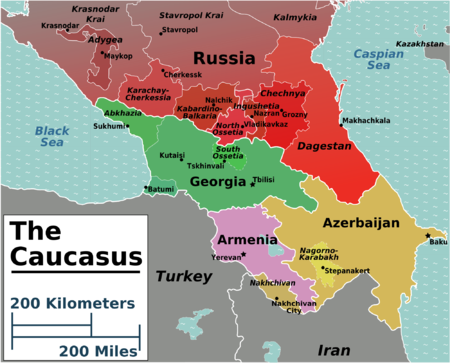
Kostina received an International Programs’ Special Projects Awards to host the event, which provides funding for small-scale international activities on the UI campus to support internationalization at Iowa. The two-day conference fostered cross-cultural dialogue and understanding between Iowa and representatives from all six countries in the Caucasus region.
“I want people to understand how amazing this place is and how many problems the Caucasus still has,” Kostina said. “They need young people—like our students—to learn about these regions so they can foster connections between the Caucasus and America.”
Situated between the Black Sea and the Caspian Sea, the region mainly comprises Armenia, Azerbaijan, Georgia, and parts of Southern Russia. It’s divided into the North Caucasus and South Caucasus, with the North being governed by Russia. Despite its deep historical, cultural, and geopolitical significance, it remains underrepresented in academics and public discourse.
“I’ve been working here [University of Iowa] for 30 years,” Kostina said. “What I’ve noticed is American students aren’t familiar with geography. So, when I tell them that this place they’ve never heard of exists, they are very interested and eager to get involved.”
The region is known for its linguistic and religious diversity, as well as its natural resources.
“It’s a very rich part of Russia, but it no longer wants to coexist with Russia,” said Kostina. “They have all the resources to live independently—oil, gas, wonderful seas and mountains—but they are not free.”
Alisa Ganieva, an award-winning Russian author from the Caucasus and past participant in the UI International Writing Program in 2012 and 2018, also spoke at the conference about the region’s ongoing conflicts and the novel she’s currently working on.
“It is very difficult to unite in the Caucasus, where these conflicts have only grown deeper over past decades,” Ganieva said. “What I am talking about has little to do with fiction… I simply gave a dotted line to some ideas that inspired me.”

Ganieva’s novels, The Mountain and the Wall and Bride and Groom, explore life in the North Caucasus. Kostina utilizes Ganieva’s books in the classroom for their relevance to current regional issues.
“I get some letters from the students at the University of Iowa who have read one of my novels, or even two of them,” she said. “They always ask such profound and wise questions, and you can feel from these questions and letters that they are genuine. They're not just written to get the grade; they really think about these issues they're reading about.”
Both Ganieva and Kostina are originally from Dagestan, a republic in the North Caucasus governed by the Russian Federation. Ganieva said Russia’s invasion of Ukraine forced her—and many others—to leave their homes.
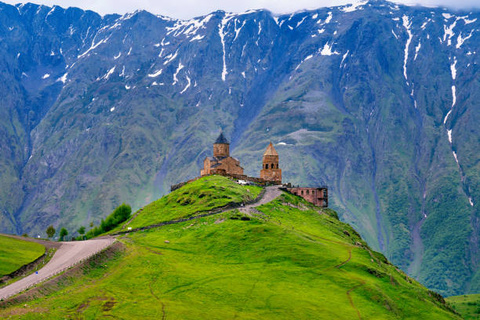
“After the full-scale war began, I had to leave for political reasons,” she said. “There is an urgent need for us to connect and come together right now, even if it’s in a virtual form.”
The virtual conference offered a global lens on contemporary issues, such as territorial conflicts, human rights, and environmental challenges—providing valuable context beyond the U.S. perspective.
“If things get better in the future, it could be a wonderful place where our students and professionals can go see and visit,” Kostina noted. “I would be very happy, because it's really kind of an unknown land and we should open it to the public.”
Kostina plans to host another event in November 2025 featuring film directors from the Caucasus who will present their documentaries to showcase the region’s cultural diversity.
“There are two sides to communication,” Kostina said. “The more we talk, the more we understand each other, and the less chance of creating more conflict. War can’t go on forever.”
This conference was co-sponsored by the UI Department of Asian and Slavic Languages and Literatures, UI International Programs, and the UI Center for Language and Culture Learning.
International Programs (IP) at the University of Iowa (UI) is committed to enriching the global experience of UI students, faculty, staff, and the general public by leading efforts to promote internationally oriented teaching, research, creative work, and community engagement. IP provides support for international students and scholars, administers scholarships and assistance for students who study, intern, or do research abroad, and provides funding opportunities and grant-writing assistance for faculty engaged in international research. IP shares their stories through various media, and by hosting multiple public engagement activities each year.