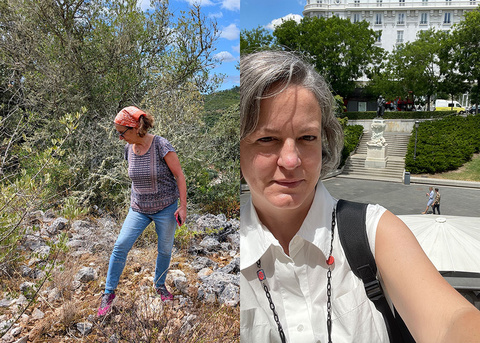
Each summer, University of Iowa (UI) faculty use the International Programs Summer Research Fellowship to engage with global issues and promote the internationalization of research on campus. Recent recipients have excavated Portuguese sites, studied Spanish archives, collaborated with Namibian educators, and explored printmaking techniques in Chile.
Each $3,000 fellowship helps faculty carry out projects that are expected to result in at least one publication, exhibit, or performance. For many recipients, the fellowship proved to be a catalyst for far more.
1. It opened doors to international collaboration
The fellowship gave faculty the chance to form lasting partnerships around the world.
“This project established new collaborations between UI and Portuguese scholars, and valuable training for all involved,” said Dr. Katina Lillios, professor of anthropology in the UI College of Liberal Arts and Sciences.
“I have made important connections at the University of Namibia and with education leaders and teachers,” said Dr. Maia Sheppard, assistant professor of social studies education in the UI College of Education.
“The residency [at Taller 99 in Santiago, Chile] allowed me to strengthen international partnerships that will support future student and faculty exchanges,” said Anita Jung, professor in the School of Art, Art History, and Design in the UI College of Liberal Arts and Sciences.
2. It helped launch bigger grants
For several faculty members, fellowship projects lead to major external funding opportunities.
“This pilot project [testing new methods for collecting and coding data on cooperation in multi-dyad civil wars] directly impacted our ability to start the NSF grant this fall,” said Dr. Elizabeth Menninga, associate professor of political science in the UI College of Liberal Arts and Sciences.
“A colleague and I formulated a proposal to the National Endowment for the Humanities to develop a much larger scale web-based repository [that highlights Medellín’s culture, history, and residents]. This was funded for $150,000 and has taken on a life of its own,” said Dr. Kristine Muñoz, professor in the Department of Spanish and Portuguese and director of global health studies in the UI College of Liberal Arts and Sciences.
“This trip confirms that my project [exploring the relationships between medical professionals, populist leaders, and popular culture in the early 20th Century by studying Asuerotherapy and its impact in Spain and Latin America] is not only feasible, but important,” said Dr. Mariola Espinosa, associate professor of history in the UI College of Liberal Arts and Sciences. “It will strengthen any future grant application I write for this project.”
3. It brought global perspectives into the classroom
Faculty found that their international work immediately enriched classroom learning and student research opportunities at Iowa.
“The research I began there—particularly with natural dyes, water-based pigments, and adapting mokuhanga to locally sourced materials—will directly inform my teaching and studio practice at the University of Iowa,” said Jung.
“I will be presenting and publishing papers based on the history curriculum study and will continue to find ways to engage in research in an international context with history teachers,” said Sheppard. “I’ll also be increasing the attention to African history in my pre-service social studies education courses.”
4. It benefited students
The fellowship also created hands-on opportunities, allowing students to work directly on faculty-led projects.
“Thanks to support from IP, I was able to travel to Portugal with my graduate student Shannon Casey to study a large collection of ceramics from the archaeological site of Agroal, Portugal,” said Lillios.
“Once the site was in place, students began contributing pages as independent study or thesis-based projects,” said Muñoz.
5. It made research possible
Finally, many faculty acknowledged that without this fellowship, much of their work wouldn’t have been possible.
“The International Programs Summer Research Fellowship was essential in supporting my month-long artist residency at Taller 99 in Santiago, Chile,” said Jung.
“The funding allowed me to spend more than two months in residence in Medellín, which was the concentrated time I needed to develop the website,” said Muñoz.
“[International Programs'] support provided me with the opportunity to expand my research into the significance of difficult histories in the secondary school curriculum to international contexts,” said Sheppard.
Learn more about IP Summer Research Fellowships
International Programs (IP) at the University of Iowa (UI) is committed to enriching the global experience of UI students, faculty, staff, and the general public by leading efforts to promote internationally oriented teaching, research, creative work, and community engagement. IP provides support for international students and scholars, administers scholarships and assistance for students who study, intern, or do research abroad, and provides funding opportunities and grant-writing assistance for faculty engaged in international research. IP shares their stories through various media, and by hosting multiple public engagement activities each year.