The Anne Frank Initiative (AFI) commits to investigating Anne Frank’s literary contributions, her ongoing legacy, and all that she represents in a more globalized, international, and contemporary context. It will open the door for intellectual minds to create opportunities for research, pedagogy, and artistic output that strive for advocacy. Events and undertakings will serve as transformative moments not only for our campus but for our state and beyond.
Anne Frank is regarded as a world-renowned, acclaimed Jewish author penning a diary that has sold over 30 million copies in over 70 languages. She has been defined as an international icon and writing figure and a global phenomenon who has come to represent equality, hope, inspiration, and courage for many. But, in the end, Anne Frank was a human being who, by representing her own personal history and narrative teaches us how we relate to one another and celebrate a shared humanity.
Anne Frank

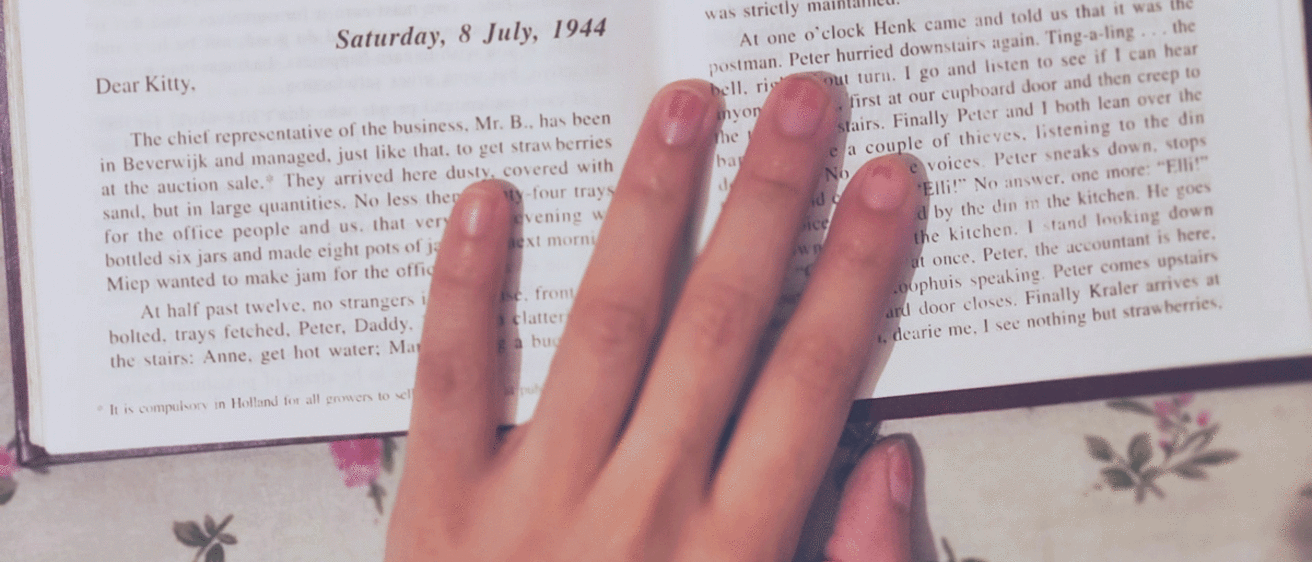
Born in Frankfurt, Germany, Anne Frank lived most of her life in or near Amsterdam, Netherlands, having moved there with her family at the age of four and a half when the Nazis gained control over Germany. Born a German national, she lost her citizenship in 1941 and thus became stateless. By May 1940, the Franks were trapped in Amsterdam by the German occupation of the Netherlands. As persecutions of the Jewish population increased in July 1942, the Franks went into hiding in some concealed rooms behind a bookcase in the building where Anne’s father, Otto Frank, worked. From then until the family’s arrest by the Gestapo in August 1944, Anne kept a diary she had received as a birthday present, and wrote in it regularly. Following their arrest, the Franks were transported to concentration camps. In October or November 1944, Anne and her sister, Margot, were transferred from Auschwitz to Bergen-Belsen concentration camp, where they died a few months later.
Otto, the only survivor of the Frank family, returned to Amsterdam after the war to find that Anne’s diary had been saved by his secretary, Miep Gies, and his efforts led to its publication in 1947. It was translated from its original Dutch version and first published in English in 1952 as The Diary of a Young Girl, and has since been translated into over 70 languages.

Book Release
Co-edited by AFI Director Kirsten Kumpf Baele, this volume illustrates how rich the ongoing engagement with Anne Frank and her legacy remain in the 21st century.
AFI News
Irish artist Katie Holten reimagines language with a tree alphabet
IPR's Talk of Iowa features Anne Frank Initiative
Anne Frank Initiative welcomes artist Katie Holten for conversation on language, memory, and the natural world
Upcoming Events