Every day, students, faculty and staff across the University of Iowa work, teach, research, and collaborate alongside people from cultural backgrounds different from their own. International Student & Scholar Services (ISSS) offers three intercultural training programs designed to help the campus community navigate those differences with more skill and confidence:
- Bridge, for undergraduate, graduate, and professional students
- Building Our Global Community (BGC), for faculty and staff
- Engaging Across Cultures (EAC), for graduate and professional students
Bridge
Bridge is a leadership training program offered each spring semester for all undergraduate, graduate, and professional students, focused on increasing self-awareness while building intercultural leadership skills.
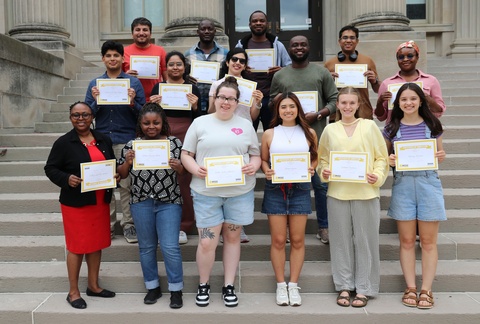
"Participating in Bridge significantly shaped my understanding of culture and global perspectives," said Ayomide Ajewole, a PhD candidate in synthetic organic chemistry. "The program broadened my appreciation for the diversity, values, and unique qualities that exist within different cultures."
Sumire Garcia, an undergraduate student majoring in business analytics and information systems, said the program's real-world grounding set it apart.
"Bridge went far beyond general theory — it gave me real-world insights into cross-cultural communication, personal reflection, and how to navigate business situations with cultural awareness," Garcia said. “One of the best parts is getting to collaborate with students across all levels, from undergraduates to masters and PhD candidates, who bring such rich, global perspectives. It’s an eye-opening experience that builds both confidence and connection.”
For Milad Arzani, a PhD candidate in biomedical engineering, Bridge reframed how he saw cultural differences.
"Cultures share more similarities than people realize," Arzani said. "True communication and listening without judgement are key."
Applications for spring 2027 will open during the fall 2026 semester. Students interested in participating can complete the Bridge interest survey to be notified when the application becomes available.
Engaging Across Cultures
Engaging Across Cultures (EAC), offered in the fall and spring semesters, is a self-paced, non-academic professional development certificate program that helps graduate and professional students apply intercultural communication skills to research, teaching, clinical work, and beyond.
Nuzhat Nuari Khan Rivu, president of the International Student Advisory Board and a PhD candidate in applied mathematical and computational sciences, said the program changed how she interprets everyday interactions.
"What stood out most to me was learning how our own cultural lens influences how we understand and communicate with others," Rivu said. "EAC reminded me that the same communication approach may not work for everyone."
That lesson, Rivu said, pushed her to listen more carefully and approach disagreement with respect rather than an "us versus them" mindset.
“These skills help us build trust, communicate more effectively, and create a more inclusive academic and professional community,” Rivu said.
Bladimir Padilla, a PhD candidate in educational measurement and statistics, found the program's value in his everyday role as a graduate teaching assistant.
"The sessions helped me reflect on and better understand how cultural differences influences my interactions with others," Padilla said. “What I learned in the EAC program has helped me reflect on the importance of intercultural skills and appreciate the diversity in our university community and our city. I hope that more students will be able to participate in programs like the EAC.”
To earn an EAC certificate, participants complete three sessions: Introduction to Engaging Across Cultures and two elective sessions. All sessions are free and available on a first-come, first-served basis. Advance registration is required.
Sign up for Engaging Across Cultures
Building Our Global Community
Where Bridge and EAC focuses on students, Building Our Global Community (BGC) is built for the faculty and staff who work alongside them. The self-paced certificate program, offered in the fall and spring semesters, explores intercultural communication and cultural adjustment — and it resonates most with people whose jobs put them in daily contact with international students and scholars.
"I work with international students daily,” said Maggie Atkinson, graduate program coordinator in the UI Department of Communication Studies and the School of Journalism and Mass Communication. “It felt like a no-brainer to participate in BGC."
Corey Rubin, an administrative affairs coordinator in the Graduate College came to BGC already familiar with cross-cultural work through his academic training in Spanish.
"The BGC program took the lessons I had learned even further," Rubin said. "It reminded me to continually reset the biases that could creep into the interactions I have with the students I serve."
For Chanelle Reese, university ombudsperson, the payoff has been practical. Her office fields concerns from people across many cultures, each sharing their story differently.
"Having obtained an assessment and a tool through these courses, the foundation remains for me to stay rooted in my understanding that resolution to concerns stems from the different perspectives and experiences that each person carries with them," Reese said.
Five BGC courses are being offered during fall 2026, with additional courses planned for spring 2027. To earn a certificate, participants must complete the Introduction to Building Our Global Community core course and at least four electives. Courses are free and available on a first-come, first-served basis. Faculty and staff can register through UI Employee Self-Service by selecting “My Career,” “Learning & Development” and “My Training,” then searching for “BGC.”
Register for Building our Global Community courses
A shared goal
Vedansh Airen, an AI support team consultant at UI Information Technology Services, has seen campus life from two different angles — first as an international student at Iowa, now as a staff member who took BGC.
"As an international student, I saw many staff and faculty go out of their way to make campus more accommodating," Airen said. "One of my biggest takeaways from BGC was that creating a welcoming environment begins with curiosity, empathy, and a willingness to listen. It offers perspectives that can make a real difference in how supported and valued international students and global talent feel."
Other participants describe a similar shift.
"I learned to see situations from other people's perspectives, even when their viewpoints differed greatly from my own," Ajewole said. "Rather than dismissing unfamiliar ideas, I became more open to understanding and valuing them."
“What I learned in the EAC program has helped me reflect on the importance of intercultural skills and appreciate the diversity in our university community and our city,” Padilla said.
Together, Bridge, BGC and EAC are helping Iowa's community see things from more than one perspective.
Learn more about intercultural training
International Programs (IP) at the University of Iowa (UI) is committed to enriching the global experience of UI students, faculty, staff, and the general public by leading efforts to promote internationally oriented teaching, research, creative work, and community engagement. IP provides support for international students and scholars, administers scholarships and assistance for students who study, intern, or do research abroad, and provides funding opportunities and grant-writing assistance for faculty engaged in international research. IP shares their stories through various media, and by hosting multiple public engagement activities each year.